
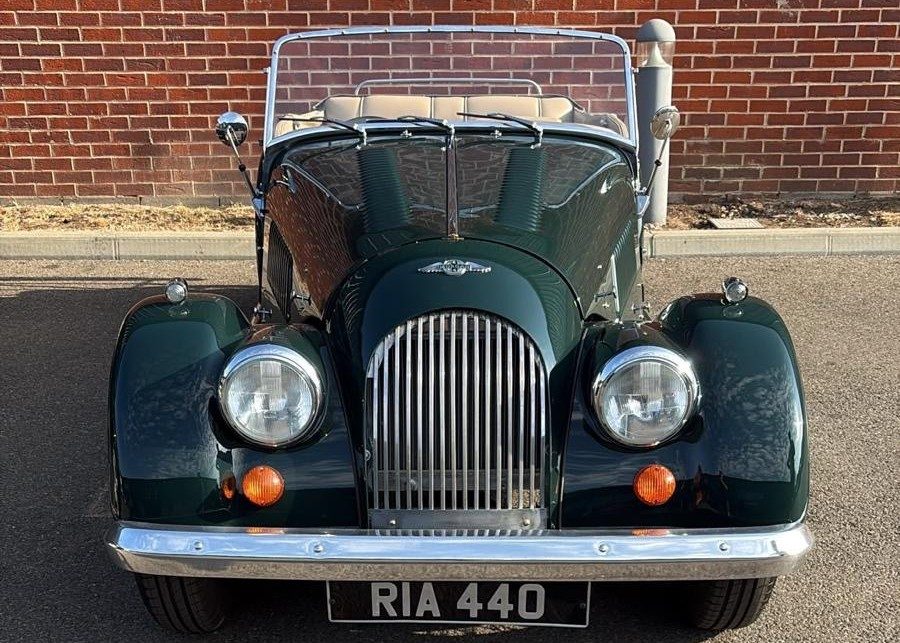
There is a particular kind of British object that does not modernise so much as continue. It is refined, quietly, for decades, by people who cannot see a reason to abandon a thing that already works. Oast houses are one. The Morgan is another, and one sits on the gravel here.
A minute of the Morgan on the estate. Nothing loads from Instagram until you ask for it.
The four-wheeled Morgan arrived in 1936. Before that the Morgan Motor Company, founded by H. F. S. Morgan and based at Malvern in Worcestershire, had built three-wheelers — light, quick, and taxed as motorcycles. The new car had four wheels and a four-cylinder engine, and the factory named it for exactly that: 4/4. Not a code, not a series. A description.
It stayed in production, with a wartime break and a pause in the early fifties, until 2018. That is a run of some seventy-three years, one of the longest of any car ever made, and across it the engine changed hands more than once — a 1,122cc Coventry Climax at the start, Ford units for most of the later life, ending on a 1.6-litre Ford Sigma. What did not change was how the thing is built: an ash frame over a steel chassis, panelled by hand, with the sliding-pillar front suspension H. F. S. Morgan patented in 1910.
That is the detail worth holding on to. The wooden frame is not decoration or nostalgia. It is the structure, shaped in a workshop, by people, one car at a time. A Morgan is coachbuilt in the old sense, which means every one of them is very slightly its own.
Ours is a 1980 four-seater. The four-seat body was always the quieter choice in the range — the same car, lengthened enough to carry two more, usually children, usually complaining about the wind. It is not a fast car by any modern measure and it was never trying to be. It is a car you drive with your hands and your ears, on a road you chose deliberately, at a speed the lanes here would insist on anyway.
We are not going to pretend to a specification sheet. It is not a concours car, it has been used, and the mechanical particulars are the owner's business and the workshop's. What we can tell you is where it lives: beside a brick barn on a fifteen-acre estate above Frant, established 1830, where it looks less like a vehicle parked outside a building and more like two versions of the same idea standing next to each other.
Because that is the honest reason it belongs here. Both were built to be maintained rather than replaced. Both are made of materials that show their age instead of hiding it — ash, brick, oak, leather, iron. Both were assembled by hand in England within a few counties of each other, and both are still doing something useful, which is more than can be said for most objects that reach their eighties.
Guests notice it. Children ask what it is. On a dry Sunday morning it gets started, warmed properly, and taken out through the lanes towards Eridge, and it comes back with the windscreen full of insects and everybody in a better mood than they left in. That is roughly what we hope the whole place does.
Both were built to be maintained rather than replaced, and both are made of materials that show their age instead of hiding it.